
If you are an eligible transitioning active-duty servicemember considering Florida after service, you have time to build a plan that reflects your experience, interests, and family priorities. The DoW SkillBridge program through Veterans Florida can be a valuable part of that plan. It gives eligible servicemembers a structured way to gain career-training experience with participating civilian organizations during the final stage of active duty. That experience can help you explore an industry, see a workplace up close, and make informed choices about your next career path.
Florida offers a broad setting for that exploration. Its large Veteran community, diverse industries, and employers that welcome military-connected talent give many servicemembers useful places to begin. SkillBridge is one transition resource among several. Career research, credential planning, informational conversations, interviews, and support from people who understand military experience can work alongside it. This guide explains what SkillBridge is, how the process generally works, and how Veterans Florida can help you prepare for a confident move toward a Florida career.
What Is SkillBridge?
The DoW SkillBridge program is a national transition program for eligible transitioning active-duty servicemembers across the Army, Navy, Marine Corps, Air Force, Space Force, and Coast Guard. It connects participants with approved civilian organizations for career training, workplace exposure, and industry learning during the last phase of military service. The program can last up to 180 days during the last six months of service, subject to applicable policy and approval and each Service's specific procedures. When participating in an approved SkillBridge internship, servicemembers retain full DoW pay and benefits during the program, subject to applicable policy.
A SkillBridge opportunity can take different forms. One may involve learning alongside an operations team, participating in a technology training environment, supporting a healthcare organization, or observing how a logistics business coordinates people, equipment, and schedules. The format depends on the organization and the learning plan. The common purpose is practical transition preparation: you can connect the capabilities you developed in uniform with the expectations of a civilian workplace.
For many servicemembers, that first-hand exposure is useful because military experience contains skills that may show up under different names in civilian settings. Leadership, maintenance, planning, communications, medical support, cybersecurity, supply, transportation, quality control, and project coordination can each connect to a range of career paths. A well-chosen SkillBridge experience gives you space to learn how an employer describes the work, what tools teams use, and where your experience fits.
SkillBridge is career training. It can also be a productive setting for learning about an employer and exploring an industry before separation. It does not replace the other parts of a sound transition plan. Resume preparation, networking, credential research, transition assistance, and conversations with people in the field can add useful perspective before, during, and after a SkillBridge experience.

The Value of Career Training and Workplace Exposure
A strong SkillBridge internship gives you more than a line on a resume. It provides you a chance to practice in a civilian environment and learn through the daily work. You may attend team meetings, work with a supervisor, shadow an expert, contribute to defined projects, receive feedback, or take part in training that helps you understand the field. Those experiences can sharpen how you talk about your military background when you meet future employers or if you stay with the employer after your internship.
Workplace exposure also helps you evaluate fit. A title or job description can introduce a role, while an on-site can show how people collaborate, how decisions are made, and what a normal workday looks like. You may come away more interested in a field than you expected. You may also decide that a neighboring role better matches your skills and goals. Either result can guide your next steps with greater clarity.
Employer learning is another meaningful part of the experience. Participating organizations have an opportunity to see the strengths servicemembers bring, including accountability, adaptability, technical knowledge, and experience working toward a shared mission. You have an opportunity to learn the organization’s language, culture, and career paths. That exchange can make later career conversations more specific and more confident.
Consider a servicemember with a background in aircraft maintenance who is interested in Florida’s aerospace and defense community. A SkillBridge experience could help that person compare several directions, such as quality assurance, technical operations, supply support, or project coordination. The goal is not to assume one military specialty maps to one civilian title. The goal is to gather practical information and build a plan around the work that fits your interests and experience.
During the program, participants retain full DoW pay and benefits. That structure can give eligible servicemembers time to focus on training and transition preparation while they remain on active duty. It is still wise to consider your personal timing, location, household needs, and other transition activities as you decide whether an opportunity makes sense for you.
Why Consider Florida for Your Next Career Step?
Florida is home to the nation’s third-largest Veteran population, according to the Florida Department of Veterans’ Affairs. That established Veteran presence can be a welcome part of settling into a new community. It also means transitioning servicemembers can look for professional and community connections with people who understand military service and the move into civilian life.
The state’s size and industry diversity create room to explore different directions. Typically known for tourism, Florida communities include employers and organizations connected to aerospace and defense, healthcare, information technology, logistics, manufacturing, education, professional services, and more. The availability of a particular opportunity will vary by location, timing, qualifications, and employer needs.
Florida has a sizeable base of employers and organizations that engage with Veterans and military-connected talent. According to the Florida Chamber Foundation, Florida’s economy reached approximately $1.8 trillion and ranked 14th globally in 2026 when compared with national economies, surpassing Mexico and Australia. That does not mean a particular company, program, or role will be the right fit for every person. It does mean you can seek out organizations that value the discipline, teamwork, technical ability, and leadership developed through service. Veterans Florida can help eligible Florida-bound servicemembers identify relevant connections and prepare to present those strengths in clear civilian language.
When you explore Florida, start with the practical questions that matter to you. Which communities support your family’s priorities? Which industries relate to your experience or interests? Would you prefer a large organization, a growing company, a public-sector setting, or a hands-on training environment? A focused set of questions can make your SkillBridge research more useful and help you compare opportunities with purpose.
 Areas of Opportunity in Florida
-
Aerospace and Defense: Florida’s aerospace and defense activity offers areas to research for servicemembers with technical, operational, maintenance, security, logistics, engineering-support, or project experience. SkillBridge opportunities in this space may help you learn about civilian standards, workflows, and roles that relate to your background.
-
Public Service: State, county, and municipal agencies offer a range of career paths for servicemembers with experience in law enforcement, administration, operations, logistics, public safety, information technology, maintenance, and program support. Opportunities may be available across agencies and communities throughout Florida. Use your planning period to research role requirements, hiring processes, and any education, certification, or licensing requirements connected to the career paths that interest you.
-
Information Technology: Information technology includes a wide range of possible directions, from user support and systems administration to cybersecurity, data, software, and project coordination. A SkillBridge experience may help you understand how a team applies technical knowledge in a business setting and which skills employers seek for a particular role.
-
Logistics: Florida’s transportation, distribution, warehousing, maritime, and supply-chain activity makes logistics another area worth exploring. Servicemembers with experience in supply, movement, maintenance, planning, or operations may find useful connections between their background and civilian logistics environments.
How the DoW SkillBridge Program Generally Works
The process begins with research. Eligible servicemembers typically identify industries, locations, and participating organizations that align with their goals. As you compare options, look for a training experience that gives you a clear view of the work and helps you develop relevant knowledge or skills. You can review information through the official DoW SkillBridge website and connect with Veterans Florida for Florida-focused support.
From there, you can consider how each opportunity fits your transition timeline. A program may include a defined learning plan, a supervisor, work-based training, professional development, or exposure to several functions within an organization. Ask the organization how the experience is structured, what you will learn, who will guide your work, and how feedback will be shared. Clear answers can help you assess whether the opportunity supports the goals you have set.
Your participation is subject to Service-specific policy and command discretion, and approval is mission-dependent rather than automatic. Veterans Florida can help you prepare a strong, well-framed request by helping you clarify the connection between the opportunity, your transition plan, and your professional development goals.
SkillBridge participation is governed by Department of War and Service-specific policies. Actual eligibility, approval, and participation are determined by your chain of command and applicable Service regulations.
Keep your planning process organized, but do not feel that you need to have every answer at once. Start with the direction you want to explore, then add detail as you learn more. A good plan can evolve when you discover a role, location, credential, or organization that better fits your goals.
An Encouraging Timeline for SkillBridge Planning
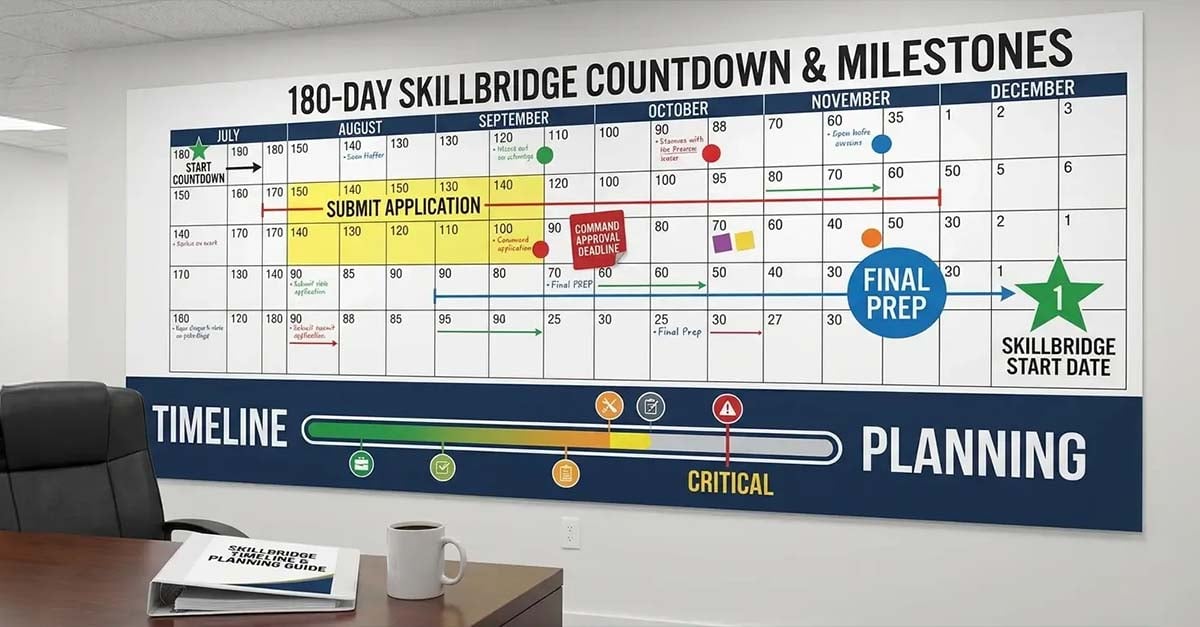
Start early to make thoughtful decisions. DoW SkillBridge may occur during your final six months, but planning should begin much earlier. Use this high-level timeline to organize research, not as a fixed sequence.
-
18 to 24 months before separation: Begin broad career exploration. Think about the work you enjoy, the skills you want to use, the locations you are considering, and the lifestyle priorities that matter to you and your family. Learn about Florida communities and industries, build your resume, and start conversations with people who work in fields of interest. Complete the application at veteransflorida.org/apply to have a Veterans Florida personal guide through your SkillBridge journey.
-
12 to 18 months before separation: Narrow your focus. Research training paths, credentials, employers, and potential SkillBridge opportunities. Attend transition events when available, update your professional profile, and identify questions you want to ask in informational conversations. This is a good time to connect your military experience to a few possible civilian directions instead of trying to select one path immediately.
-
6 to 12 months before separation: Compare the opportunities that most closely align with your goals and your projected transition window. Ask about training objectives, the work environment, supervisor support, schedule expectations, and the experience you can expect to gain. Review the applicable requirements with your Service and installation resources, then prepare the information needed for your request.
-
During the final six months: If an opportunity is approved and available, participate with clear goals. Keep notes on the projects, tools, training, and accomplishments that you can later describe in your resume and interviews. Continue building your network, learning about your target field, and preparing for your post-service career search.
This timeline works alongside other transition activities. You can schedule informational conversations, pursue credentials where appropriate, prepare for interviews, and keep researching employers while you plan for SkillBridge. Each activity gives you a different view of the civilian career landscape. Together, they can support a more informed decision.
How to Evaluate a SkillBridge Opportunity
The right opportunity is one that supports the learning and career exploration you want to do. Start by defining what you hope to gain. You may want direct experience in a target industry, a better understanding of a civilian role, practice using a technical tool, or a chance to learn from a professional team. When your goals are clear, it is easier to recognize whether a program is a good match.
A constructive conversation with the Veterans Florida team and a participating organization can help you understand the experience before you make a decision. Ask how the program is organized and how a typical week may look. Learn what projects, training, or workplace exposure are included. Find out who will supervise your work and how you can ask for feedback. You can also ask how the organization helps participants understand its field and the career paths connected to the work.
It can be helpful to ask what preparation would make you a stronger participant. An employer may recommend that you review a software platform, learn industry terminology, complete a credential, or bring examples of relevant military experience. Treat that guidance as useful information for your planning. You can decide which preparation steps fit your schedule and broader transition priorities.
Look for an experience with a clear purpose and an environment where you can learn. A well-developed program often outlines learning objectives, provides a point of contact, offers meaningful workplace exposure, and sets expectations for communication. These elements can help you stay focused and give you material to discuss in future career conversations.
While the goal of an internship is to gain employment with the employer, remember that a SkillBridge opportunity is a chance to learn, not a promise of a particular outcome. The relationships, knowledge, and practical examples you gain can be valuable as you continue your career search. Stay open to what you discover. A program may confirm your direction, introduce you to a related field, or help you refine the kind of workplace you want to join.
Make Your SkillBridge Experience Part of a Broader Plan
Before you begin, write down a few goals for the experience. For example, you may want to understand how a civilian operations team measures performance, build confidence discussing your technical background, or identify the training needed for a future role. Share those goals with your internship supervisor when appropriate. Clear goals make it easier to notice your progress and ask for the kind of learning that will be most useful.
As you participate, collect examples of your work. Keep track of projects you supported, tools you learned, team contributions, training completed, and problems you helped address. Focus on accurate, concrete descriptions. Later, you can use those notes to update your resume, prepare interview examples, and explain how your military experience and SkillBridge training connect to the career path you are pursuing.
Continue to use the other resources available to you. Talk with people in your field, research organizations in Florida, attend career events, and review credential requirements where they apply. Veterans Florida’s Career program may be a helpful next step for Veterans who have already separated and are seeking career preparation and placement support. The Entrepreneur program is another resource for eligible Veterans interested in starting or growing a small business. Program eligibility and requirements may apply.
A broader plan also includes the people closest to you. Discuss location, schedule, household needs, and your career interests with your spouse or family. Their perspective can help you evaluate the practical fit of an opportunity. You do not have to make the transition plan alone. Bringing the right people into the conversation early can make your decisions feel more grounded. Veterans Florida may also be able to assist your spouse with employment or entrepreneur resources.

Prepare for Your Florida Career With Veterans Florida
Your military experience has prepared you to learn, lead, solve problems, and work toward a mission. As you plan your move from active duty to civilian life, SkillBridge offers a practical, real-world setting to apply those strengths, explore a field, and learn what comes next. Florida’s broad communities and industries give you a strong place to begin researching the career path that fits your goals.
Veterans Florida is a Florida-based resource for eligible transitioning servicemembers who want to explore SkillBridge opportunities and prepare for a career in the state. Our team of veterans can help you think through your options, communicate your experience in civilian terms, and prepare for the conversations ahead. Support is available at no cost to you.
Whether you are starting research 24 months from separation or organizing your final six months of active duty, a clear next step can build momentum. Take time to explore, ask thoughtful questions, and choose opportunities that help you learn. Your experience matters, and your next career chapter deserves a plan built around your strengths.